
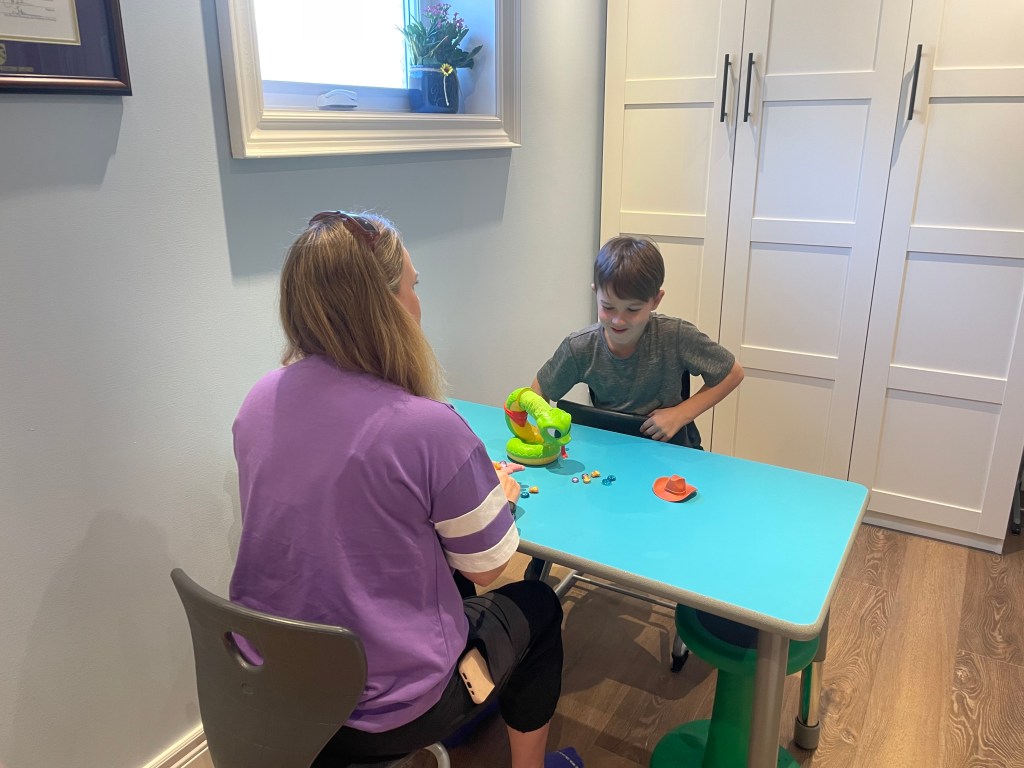
What Services Do We Provide?
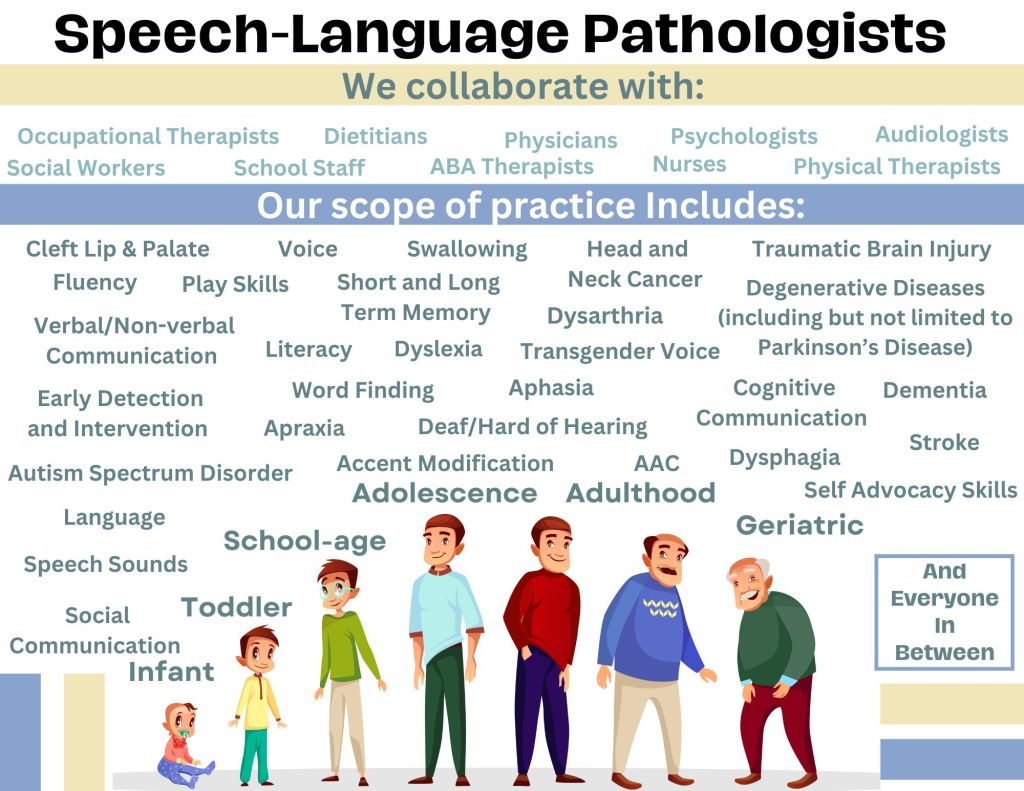
We offer comprehensive assessments, treatments, and consultations for a wide range of speech and language disorders. Our practice focuses on articulation therapy (sound production), literacy (reading and writing), and stuttering therapy, but has experience with a wide range of communication concerns. Here are just a few examples of the speech and language disorders in alphabetical order that we address in our office. Don’t see your concern here? Ask!
Apraxia of Speech
Apraxia of speech is a neurological speech disorder where the brain has difficulty planning the specific movements needed to produce speech, even though the muscles themselves are strong and able to move. It’s not a weakness in the speech muscles, but rather a problem with the brain’s ability to sequence those movements. Treatment will be based on evidence-based programming such as (but not limited to) Prompts for Restructuring Oral Muscular Phonetic Targets (PROMPT), Dynamic Temporal and Tactile Cueing (DTTC) and Kaufman Programming.
Articulation/Speech Sound Disorders
Is it a tricky “R” sound? Or words like “shoe” sounding like “sue,” or maybe just a bunch of speech sounds coming out all jumbled? We will assess, determine the pattern and suggest a personalized treatment plan. We also have extensive experience working with kids who have frontal and lateral lisps and other distortions of speech sounds.
Cognitive-Communication Disorders
Challenges with higher-level thinking and communication skills, often resulting from a brain injury can occur. We can work with you and your family to determine how to accommodate and compensate for these challenges and/or ways to strengthen your communication skills.
Fluency/ Stuttering
We support confident, effective communication by reducing the impact of stuttering and empowering individuals and families with strategies that align with their needs and goals. Stuttering therapy is effective for pre-school and school age children as well as adults! Remember, the goal is NOT to achieve perfection or 100% fluency—after all, none of us have perfect speech—but to be able to express yourself freely and boldly, saying exactly WHAT you want to say and WHEN you want to say it.
Language Development
Not sure if your little one is a “late talker”? Some children need a little extra support in putting words into sentences, learning new vocabulary and grammar. Is your school-aged child having trouble with grammar, vocabulary, telling stories, following directions, understanding what they read and/or hear? We support that too!
Literacy/Reading and Writing
Reading and writing, at their very essence, are powerful forms of language! It’s no wonder that for some children, extra support from tutors can sometimes lead to increased frustration instead of clarity. That’s where personalized programming for a Speech-Language Pathologist comes in! Often used is the Ascend SMARTER Intervention Program. SMARTER stands for Systematic, Multi-sensory, Applied, Research-based, Targeted, Explicit, and Realistic techniques. Not only does this framework promote learning and retention of learned skills but it also builds self confidence. Children feel empowered and confident after the program!
Neurologic Causes- Amyotrophic Lateral Sclerosis (ALS), Parkinson’s Disease (PD), Multiple Sclerosis (MS), Dementia
Neurologic causes for speech-language difficulties include but not limited to Parkinson’s disease (PD), multiple sclerosis (MS), amyotrophic lateral sclerosis/Lou-Gehrig’s disease (ALS), and dementia. These conditions often impact speech-language and cognitive abilities. Treatment will be personalized to determine best courses of action. We have extensive training in Lee Silverman Voice Therapy-LOUD (LSVT-LOUD). This is an evidence-based behavioural treatment program designed to improve speech and voice function.
Tongue Thrust/Swallowing Disorders
Tongue thrust refers to the habit of pushing the tongue forward while swallowing, speaking and/or at rest. Often, but not always, there are speech distortions with “s”,“z”, “sh”, and/or “ch” with children who present with a tongue thrust. Treatment will work through a hierarchy of foods and liquids to create a new swallowing pattern to remove the tongue thrust.
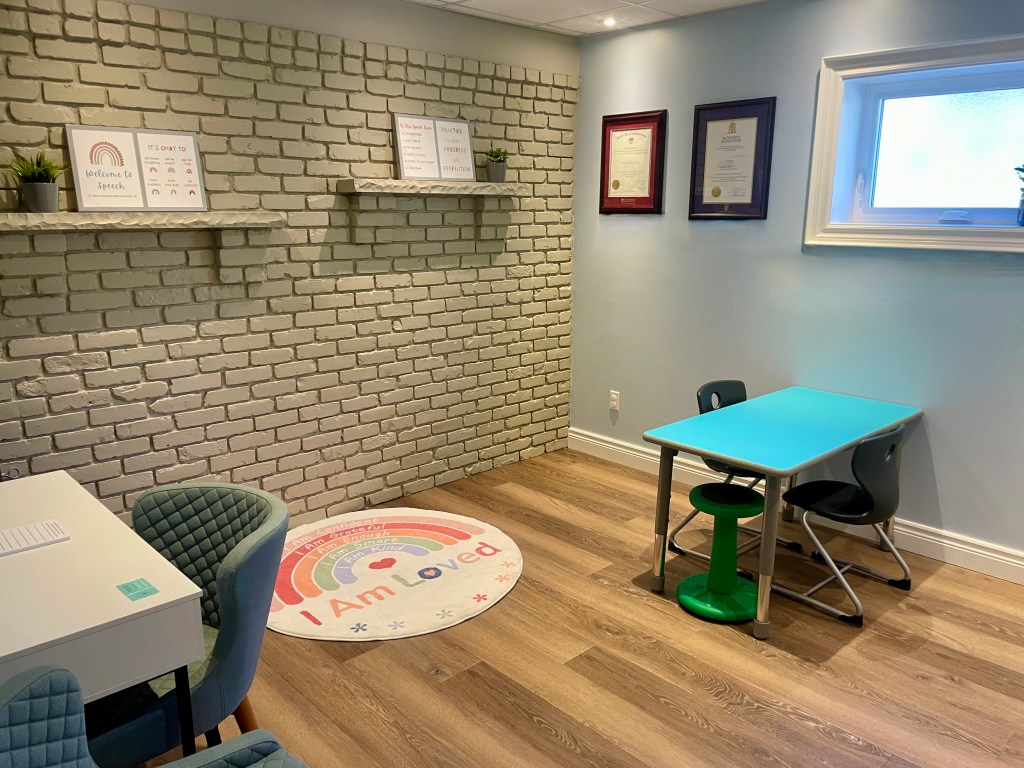
Our therapy space is warm and inviting, creating a comfortable place that encourages growth and learning.
“Never assume a person who has difficulty communicating has nothing to say” – Stacy Skinner
 Halton Hills Speech & Language Services